
How to Connect Blog Content to Vehicle Detail Pages
Turn your blog into a VDP traffic engine. See how to connect content to inventory pages with practical SEO for car dealerships that moves shoppers deeper into your funnel.
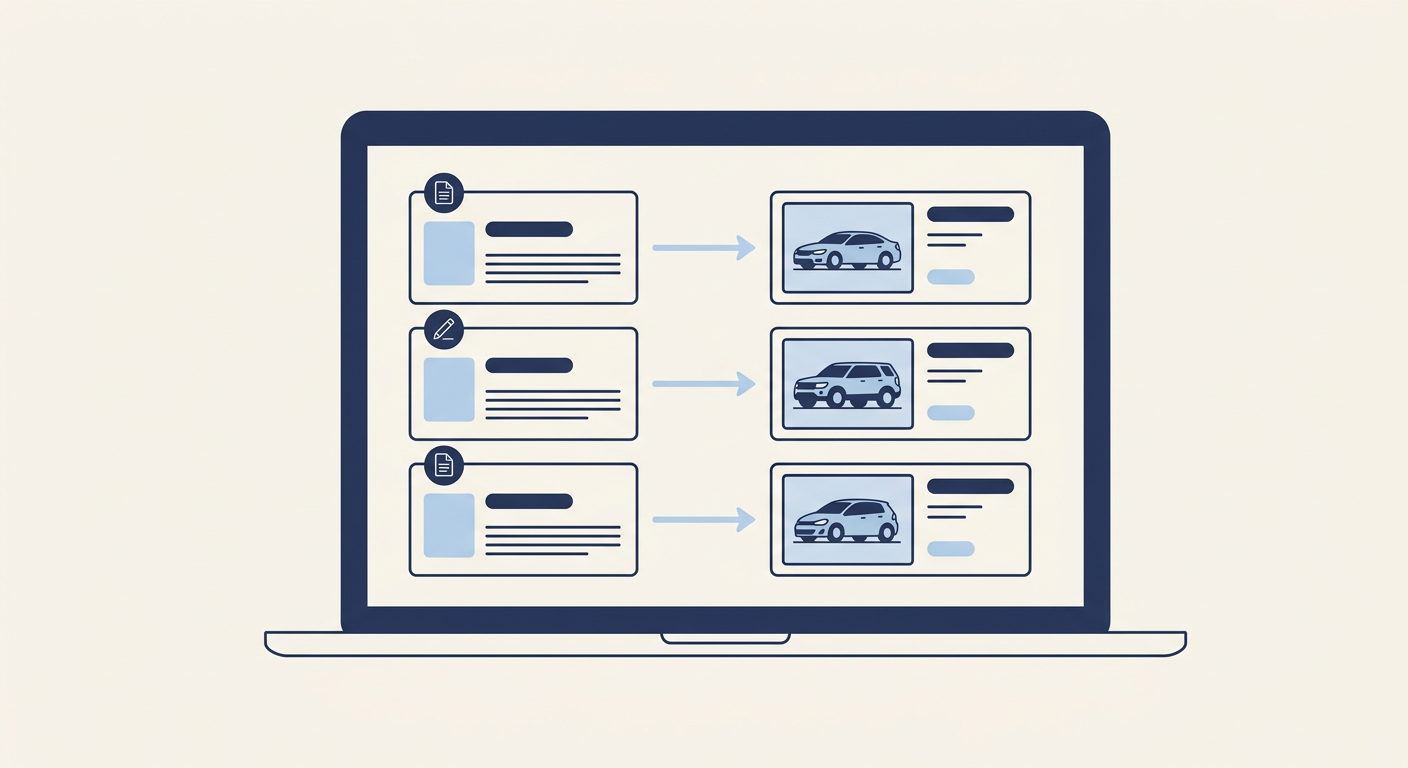
Your blog pulls traffic. Your VDPs sell cars. Connect them.
If blog readers don’t click to inventory, you’re doing free education for your competitors.
Here’s how to bridge content and VDPs with a repeatable plan your team can execute.
This playbook shows how to connect blog content to VDPs using practical seo for car dealerships, from topic mapping to link placement and measurement. If you’re new to local ranking strategy, skim our overview of car dealership SEO after this.
Why your blog should feed your VDPs
Blog traffic is mostly top and mid-funnel. Shoppers are researching trims, features, towing, winter driving, and ownership questions.
A clear path from each post to the right VDPs turns research into action and reduces exits back to Google.
Do that consistently and you’ll see higher engagement, more qualified sessions on inventory, and stronger signals that help the whole site rank.
- Reduce bounce and pogo-sticking back to search
- Shorten the path from question to product
- Pass topical authority to inventory pages
- Capture buyers researching outside of business hours
How SEO for car dealerships improves with smart internal links
Internal links help search engines understand which pages matter and how topics connect. They also guide shoppers where to click next.
When posts cluster around a model page and point into related VDPs, you concentrate authority and make it easier for new inventory pages to get discovered.
The key is relevance. Link only when the blog intent matches the inventory a shopper would actually consider next.
Map blog topics directly to inventory
Start with your lot. Then build topics that naturally point to what you sell today and cycles you’ll stock all year.
- Model research: “Honda CR-V Towing Capacity” → CR-V model page → current CR-V VDPs
- Trim explainer: “Toyota Camry SE vs XSE” → Camry model page → SE/XSE VDPs
- Seasonal: “Best AWD Cars for Winter in Denver” → AWD filter page → AWD VDPs
- Use-case: “Top Family SUVs with 3rd Row” → 3-row SUVs category → matching VDPs
- Feature: “Apple CarPlay on Used Trucks” → used trucks with CarPlay filter → VDPs
Avoid topics that can’t reasonably link to what you have. If inventory is light, target evergreen content that will rotate to new arrivals without rewrites.
Build content clusters around your core models
Pick 3–6 high-margin or high-volume models. Create a cluster for each: research guides, comparisons, ownership tips, local angles, and FAQs.
Every post should link upstream to the model page and downstream to current VDPs. The model page links back to the articles and to VDPs.
- Choose a hub (model landing page) and list its child pages
- Outline 8–12 posts that answer shopper questions on that model
- Interlink posts laterally and back to the hub
- From posts, link to 2–4 highly relevant VDPs at any given time
- Update VDP links monthly to keep them fresh
On-page linking tactics that send shoppers to VDPs
Don’t bury your links. Place them where readers decide what to do next.
- Primary in-text links near problem/solution moments
- A mid-article “See Vehicles That Match This” module pulling live inventory
- Image or button CTAs that echo intent (“Shop AWD SUVs Nearby”)
- Comparison tables with model links and a “View Local Listings” row
- FAQ answers that point to filtered inventory or flagship VDPs
Dynamic inventory modules help a lot. If your CMS allows, surface 2–4 matching vehicles inline so readers can click into the most relevant option immediately.
| Approach | CTR to VDP | Crawl depth to VDP | Ranking impact | Maintenance effort |
|---|---|---|---|---|
| No blog-to-VDP links | Low | High | Minimal | Low |
| Footer-only CTA link | Medium | Medium | Moderate | Low |
| In-text + module + FAQ deep-links (clustered) | High | Low | Strong | Medium-High |
Anchor text that matches shopper intent
Your anchor text should confirm the click will solve their exact question.
- “Shop used AWD SUVs under 60k miles” when discussing winter traction
- “See Camry XSE in stock” after a trim comparison
- “View fuel-efficient commuters nearby” on MPG guides
- “Browse 3rd-row SUVs” in family-hauling posts
Keep it natural and varied. Avoid stuffing make/model repeatedly. For link volume, a practical baseline is 1–3 VDP or filtered-inventory links per 500 words. For more on balance and placement, see our guide on how many internal links a dealership blog should have.
Use schema, breadcrumbs, and nav to reinforce relevance
Technical context boosts your content signals and helps users backtrack with confidence.
- Use Article schema on blogs and Product schema on VDPs
- Ensure breadcrumbs reflect the model/category path for both blogs and VDPs
- Keep a consistent top-nav path to inventory and model hubs
- Link to the same canonical model/trim pages from all related posts
Measure what matters: from blog click to lead
You can’t improve what you don’t track. Tie blog sessions to VDP engagement and lead actions.
- Blog → VDP click-through rate (CTR)
- VDP engagement from blog source: time on page and scroll depth
- Micro-conversions: click-to-call, map clicks, save vehicle, email share
- Lead forms and chat starts attributed to blog traffic
- Assisted conversions: blog sessions that preceded a later lead
Run controlled tests. Move modules higher, adjust anchor text, or add a mid-article VDP widget and watch CTR and lead rate shift over 2–4 weeks.
Automate the workflow so links never go stale
Inventory changes daily. Your links should update without a rewrite every time a unit sells.
Use rules-based inventory modules in posts where possible, and centralize link targets so you can swap VDPs across multiple posts at once. Platforms like our dealership SEO software make this maintenance predictable and fast.
If you prefer a fully managed approach, a specialized content partner can handle topic mapping, internal linking, and monthly refreshes for you. See our car dealership blog service for a hands-off option.
- Create dynamic widgets that pull inventory by tag/trim/body style
- Maintain a spreadsheet of “link targets” per post and update monthly
- Use parameters/UTMs to track blog-sourced VDP clicks
- Set reminders to rotate highlighted VDPs every 2–4 weeks
Editorial checklist for SEO for car dealerships content
Before you publish, run each post through a short, consistent checklist.
- One clear search intent tied to an inventory path
- 2–4 natural in-text links to the right VDPs or filtered inventory
- A mid-article inventory module above the fold on mobile
- Anchor text that promises a helpful next step
- At least one link back to the model or category hub
- Schema, breadcrumbs, and nav verified
- UTMs added to VDP links for tracking
Mistakes to avoid when linking to VDPs
A few gotchas can tank performance or create busywork.
- Linking to sold or irrelevant units; prefer filtered inventory + 1–2 hero VDPs
- Using generic anchors like “click here” or “view more”
- Over-linking every sentence; prioritize the best 2–3 spots
- Hiding links below long walls of text on mobile
- Letting posts age without rotating VDPs monthly
- Skipping measurement; it’s hard to justify content without proof
- Ignoring resourcing; plan editorial and update cadence with a realistic budget. If you’re scoping partners, here’s how dealership SEO pricing typically works.
Simple rollout plan for your store
You don’t need to rebuild your blog. Start small, prove lift, then scale.
- Week 1: Pick 3 core models, audit 10 related posts, map 2–4 VDP targets per post
- Week 2: Add in-text anchors and a mid-article inventory module to those posts
- Week 3: Set up UTMs, dashboards, and a monthly rotation cadence
- Week 4: Review CTR to VDP, adjust anchors/placement, expand to 10 more posts
- Ongoing: Publish 4–8 new posts/month inside your clusters and refresh links monthly
Ready to operationalize this? See plans and next steps on our pricing page, or keep reading below to refine the playbook.
Final thoughts
Your blog should do more than attract readers. It should route qualified shoppers to the right vehicles in as few clicks as possible.
Tie every post to a nearby action, use intent-matched anchors, and refresh links as inventory changes. That’s practical seo for car dealerships you can feel on your VDPs.
If you keep the focus on shopper intent and maintain your clusters, your blog becomes a compounding asset—educating, ranking, and moving units year-round.
Related resources
- Car Dealership SEO — Big-picture strategies that support your blog-to-VDP plan.
- Car Dealership Blog Service — Done-for-you blogging with internal linking to inventory.
- Dealership SEO Software — Automate content, interlinking, and updates at scale.
- How Many Internal Links Should a Dealership Blog Article Have? — Practical guidance on link volume and placement.
- Dealership SEO Pricing: What You Should Actually Be Paying — Budgeting insights for your content plan.
- Pricing — Compare plans when you’re ready to publish and scale.
Related articles
How to Make Vehicle Detail Pages More Useful for Search
Turn your VDPs into pages that rank and convert. Practical steps to make vehicle detail pages more useful for search and shoppers.
Aug 8, 2026 · 8 minDealer SEOWhy Blog Content Still Matters for Car Dealership SEO
Blog content still matters for car dealership SEO when it answers buyer questions, supports inventory pages, and helps dealers appear in Google and AI search.
Jul 4, 2026 · 7 minDealer SEONew vs Used Vehicle Content: Why It Works for Dealership SEO
See why blending new and used vehicle content attracts local shoppers and improves conversions, with a practical plan for car dealership SEO.
Jul 23, 2026 · 8 minDealer Blogs publishes intent-led articles that link directly to your live inventory. Automated, consistent, and built for measurable SEO gains on your VDPs.