
Writing Content That Ranks for Dealerships: A Practical Guide
Learn how dealerships can write SEO-focused content that ranks in Google, supports inventory pages, answers buyer questions, and attracts more qualified shoppers.
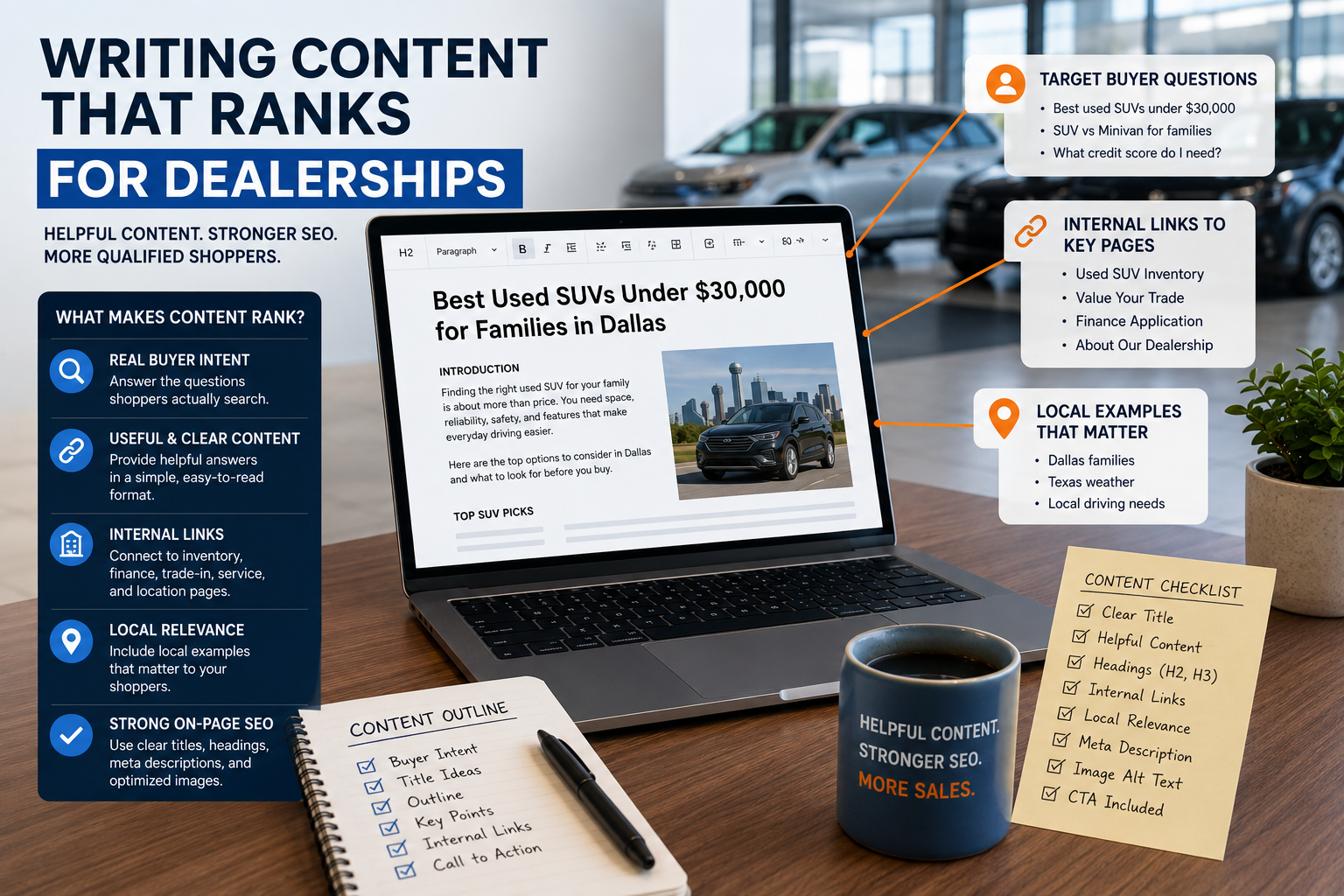
Ranking dealership content is not about publishing more words.
It is about publishing the right information in the right structure for the right shopper.
A dealership blog article should not feel like filler content. It should answer a real buyer question, support an important website page, and help a shopper move closer to taking action.
That action could be browsing used inventory, starting a finance application, valuing a trade, scheduling service, or contacting the store.
For car dealerships, RV dealers, powersports dealers, marine dealers, and other vehicle retailers, content that ranks usually has one thing in common:
It helps the shopper make a better decision.
This practical guide explains how to write dealership content that has a better chance of ranking in Google, being understood by AI search tools, and supporting the pages that actually drive leads.
Start with real buyer intent
The best dealership content starts with buyer intent.
Buyer intent means understanding what the shopper is trying to accomplish when they search.
Some shoppers are researching. Some are comparing. Some are trying to understand financing. Some are deciding whether to trade in. Some are looking for a specific type of vehicle. Some are ready to contact a dealership.
Your article should match that intent.
For example, a shopper searching “best used SUVs under $30,000 in Dallas” is probably much closer to a purchase than someone searching “history of SUVs.”
A shopper searching “can I finance a used truck with average credit” may be a strong finance lead.
A shopper searching “SUV vs minivan for families in Chicago” is likely comparing real vehicle options.
Good dealership content does not begin with “what do we want to say?” It begins with “what is the shopper trying to figure out?”
Choose topics that connect to dealership goals
Not every blog topic is worth writing. A dealership should focus on content that supports real business outcomes.
Strong dealership content usually connects to at least one of these areas:
- New inventory
- Used inventory
- Vehicle category pages
- Finance applications
- Trade-in tools
- Service scheduling
- Parts pages
- Location pages
- Model research pages
- Comparison pages
For example, an article about “best used trucks for towing in Houston” can support used truck inventory. An article about “how trade-in value affects your next vehicle purchase” can support the trade-in page. An article about “what credit score do you need to finance a used SUV” can support the finance application.
The article should not exist in isolation. It should support a page or action that matters.
Use specific titles instead of generic titles
Generic titles are one of the biggest problems with dealership blogging. A title like “5 Car Buying Tips” is too broad. It could apply to any dealership, in any market, for any buyer.
A stronger title is more specific. For example:
| Generic title | Stronger dealership SEO title |
|---|---|
| 5 Car Buying Tips | Best Used SUVs Under $30,000 for Families in Dallas |
| Truck Buying Guide | What to Look for When Buying a Used Truck for Towing in Houston |
| Financing Advice | What Credit Score Do You Need to Finance a Used Car? |
| SUV Comparison | Honda CR-V vs Toyota RAV4: Which SUV Fits Your Daily Drive? |
| Trade-In Tips | What Affects Your Trade-In Value Before Buying Your Next Vehicle? |
Specific titles usually perform better because they match how real shoppers search. They also make the article easier to write because the topic has a clear direction.
Write a helpful introduction
The introduction should quickly confirm that the reader is in the right place.
Do not waste the first few paragraphs with generic statements like: “Buying a car is an exciting experience.” Instead, get directly to the problem or question.
For example: “If you are comparing used SUVs under $30,000, the goal is not just finding the lowest price. You want a vehicle that fits your daily driving, family needs, cargo space, fuel economy, and long-term ownership plans.”
That kind of introduction is more useful. It immediately tells the reader that the article understands their situation.
A good dealership article intro should:
- State the shopper’s problem
- Explain what the article will cover
- Avoid fluff
- Set up the next step
- Keep the reader moving
Structure the article for easy scanning
Most shoppers do not read every word. They scan. That means structure matters.
Use clear H2 and H3 headings that explain the article before someone reads the full text. For example, in an article about used SUV shopping, strong headings might include:
- What should you look for in a used SUV?
- How much cargo space do you need?
- Is mileage or age more important?
- Should you finance or pay cash?
- How does your trade-in affect your budget?
- When should you schedule a test drive?
These headings help readers. They also help search engines understand the page.
Avoid vague headings like Overview, More Information, Things to Know, or Final Thoughts. Clear headings make the article more useful.
Answer the question directly
A dealership blog article should not dance around the answer. If the title asks a question, answer it.
For example, if the article is called “What Credit Score Do You Need to Finance a Used Car?” the article should explain that credit requirements vary by lender, vehicle, down payment, income, and overall application details.
It should not guarantee approval. It should not invent exact terms. It should not claim every buyer qualifies.
A safer answer might be: “Credit score can be one factor in a financing decision, but lenders may also review income, down payment, vehicle details, current debt, and overall credit history. The best next step is to complete a finance application or speak with the dealership’s finance team about available options.”
That answer is useful without making risky claims.
Add practical examples
Examples make dealership content easier to understand. Use recognizable markets and real shopping scenarios.
- A shopper in Phoenix may prioritize fuel economy, air conditioning performance, and commuting comfort.
- A shopper in Denver may care more about AWD, ground clearance, and winter driving confidence.
- A shopper in Houston may be comparing trucks for towing, job sites, and weekend hauling.
- A shopper in Los Angeles may be thinking about commuting, parking, fuel economy, and hybrid options.
- A shopper in Chicago may care about winter driving, highway comfort, and cargo space.
These examples make the article feel more relevant. They also help create content that matches how people think about vehicles in real life.
Link to important dealership pages
Internal links are a major part of dealership content. A blog article should guide the shopper toward the next logical step.
For example, an article about used SUVs should link to:
- Used SUV inventory
- Used vehicle inventory
- Finance application
- Trade-in appraisal
- Contact page
- Related SUV comparison articles
An article about financing should link to:
- Finance department
- Online credit application
- Used inventory
- New inventory
- Trade-in page
- Payment calculator if available
An article about service should link to:
- Service scheduler
- Oil change page
- Brake service page
- Tire service page
- Parts department
Internal links help users move through the site. They also help search engines understand which pages are important. A blog article without internal links is often a missed opportunity.
Avoid risky dealership claims
Dealership content needs to be useful, but it also needs to be safe. Avoid claims like:
- Guaranteed approval
- Lowest prices
- Best dealership
- Cheapest used cars
- Everyone qualifies
- This vehicle is in stock unless inventory is confirmed
- Exact payments or APRs unless verified
- Manufacturer rebates unless current and verified
Use safer phrases like:
- Browse current inventory
- See available vehicles
- Ask about financing options
- Contact our team for current details
- Vehicle availability may change
- Financing options may vary
- Trade-in value depends on condition, mileage, market demand, and vehicle history
Good content can still be persuasive without overpromising.
Make the article locally useful
Local relevance can help dealership content stand out. That does not mean forcing city names into every paragraph. It means using local context when it helps the shopper.
- Used trucks for towing in Houston
- Best commuter vehicles for Los Angeles drivers
- AWD SUV considerations for Denver shoppers
- Family SUV shopping in Dallas
- Used car financing questions in Phoenix
- Winter service reminders for Chicago drivers
- Electric vehicle research for Seattle shoppers
- Trade-in timing for Atlanta shoppers
Local examples should feel natural. The goal is to make the article useful for shoppers in the markets the dealership wants to reach.
Optimize the basic on-page SEO elements
Strong content still needs strong on-page SEO. Each dealership article should include:
- A clear SEO title
- A helpful meta description
- One H1 heading
- Logical H2 and H3 headings
- Descriptive image alt text
- Internal links
- A clear URL slug
- A final call to action
- Article schema if supported
- A featured image in the schema image field
For example, this article’s URL slug is simple and readable: /blog/writing-content-that-ranks-for-dealerships-practical-guide
Avoid long, messy, or auto-generated URLs. Clean structure helps both users and search engines.
Write for humans first, then search engines
The purpose of SEO content is not to trick Google. It is to create useful pages that search engines can understand and shoppers actually want to read.
That means avoiding:
- Keyword stuffing
- Repeating the same phrase unnaturally
- Thin content
- Generic AI filler
- Long blocks of text
- Overly promotional language
- Unhelpful introductions
- No clear next step
A good test is simple: Would this article help a real shopper make a better decision? If the answer is yes, the article is on the right track.
Practical dealership content checklist
Before publishing a dealership blog article, review this checklist:
- Does the article answer a real buyer question?
- Does the title match search intent?
- Is the article connected to inventory, finance, trade-in, service, or location pages?
- Does the intro get to the point quickly?
- Are the headings clear and useful?
- Does the article include practical examples?
- Are internal links included naturally?
- Does the article avoid risky claims?
- Is the meta title clear?
- Is the meta description helpful?
- Is the featured image relevant?
- Is image alt text included?
- Does the article have a clear CTA?
- Does the article support a real dealership goal?
If the answer is yes to most of these, the article has a much better chance of helping the dealership.
Content that ranks usually has a job to do
The best dealership content is not random. It has a purpose.
Some articles attract early research traffic. Some support inventory pages. Some answer finance objections. Some encourage trade-in submissions. Some build local relevance. Some support service appointments. Some help shoppers compare models.
Before writing, decide what job the article should do. For example:
| Article topic | Job |
|---|---|
| Best Used SUVs Under $30,000 in Dallas | Attract used SUV shoppers and guide them to used SUV inventory. |
| What Affects Your Trade-In Value? | Educate shoppers and encourage trade-in appraisal submissions. |
| Should You Lease or Finance Your Next Vehicle? | Support finance page traffic and help shoppers understand options. |
When the article has a job, it is easier to write and easier to measure.
Final thoughts
Writing content that ranks for dealerships is not about chasing every keyword. It is about understanding real buyer questions and creating helpful pages that support the dealership’s website.
The strongest dealership content is specific, useful, well-structured, locally relevant, internally linked, and connected to business outcomes.
A good article should help the shopper and help the website. That is the balance.
When dealerships publish content this way consistently, they create more opportunities to appear in search results, support important pages, build trust, and attract better shoppers before they choose where to buy.
Suggested internal links for this article
Link this article to the following pages on your dealership website:
- How to Turn Buyer Questions Into Dealership Website Traffic
- Why Blog Content Still Matters for Car Dealership SEO
- The Dealership Content Strategy Most Stores Are Missing
- What Are Buyer-Intent Keywords for Car Dealerships?
- How Blog Articles Should Link to Inventory, Finance, and Trade-In Pages
- How to Get Your Dealership Found in Google and ChatGPT
Related articles
SEO for Auto Service Shops: How Content Brings in More Service Customers
How automotive SEO services and smart content help auto service shops attract more local repair customers and steady shop bookings.
Sep 6, 2026 · 8 minDealer SEOSEO for Trailer Dealers: Local Content That Drives Buyer Leads
Practical trailer dealer SEO tactics to publish local content, rank for buyer searches, and turn clicks into calls, form fills, and walk-ins.
Sep 5, 2026 · 8 minDealer SEOContent Quality vs Quantity for Dealership SEO: What Actually Matters?
Should dealerships publish more blog posts or better blog posts? Learn how content quality, consistency, buyer intent, and internal linking all impact dealership SEO results.
Jul 7, 2026 · 8 minDealer Blogs helps dealerships publish SEO-focused articles that answer buyer questions, support inventory pages, connect to finance and trade-in tools, and improve visibility in Google and AI search.