
Content Quality vs Quantity for Dealership SEO: What Actually Matters?
Should dealerships publish more blog posts or better blog posts? Learn how content quality, consistency, buyer intent, and internal linking all impact dealership SEO results.
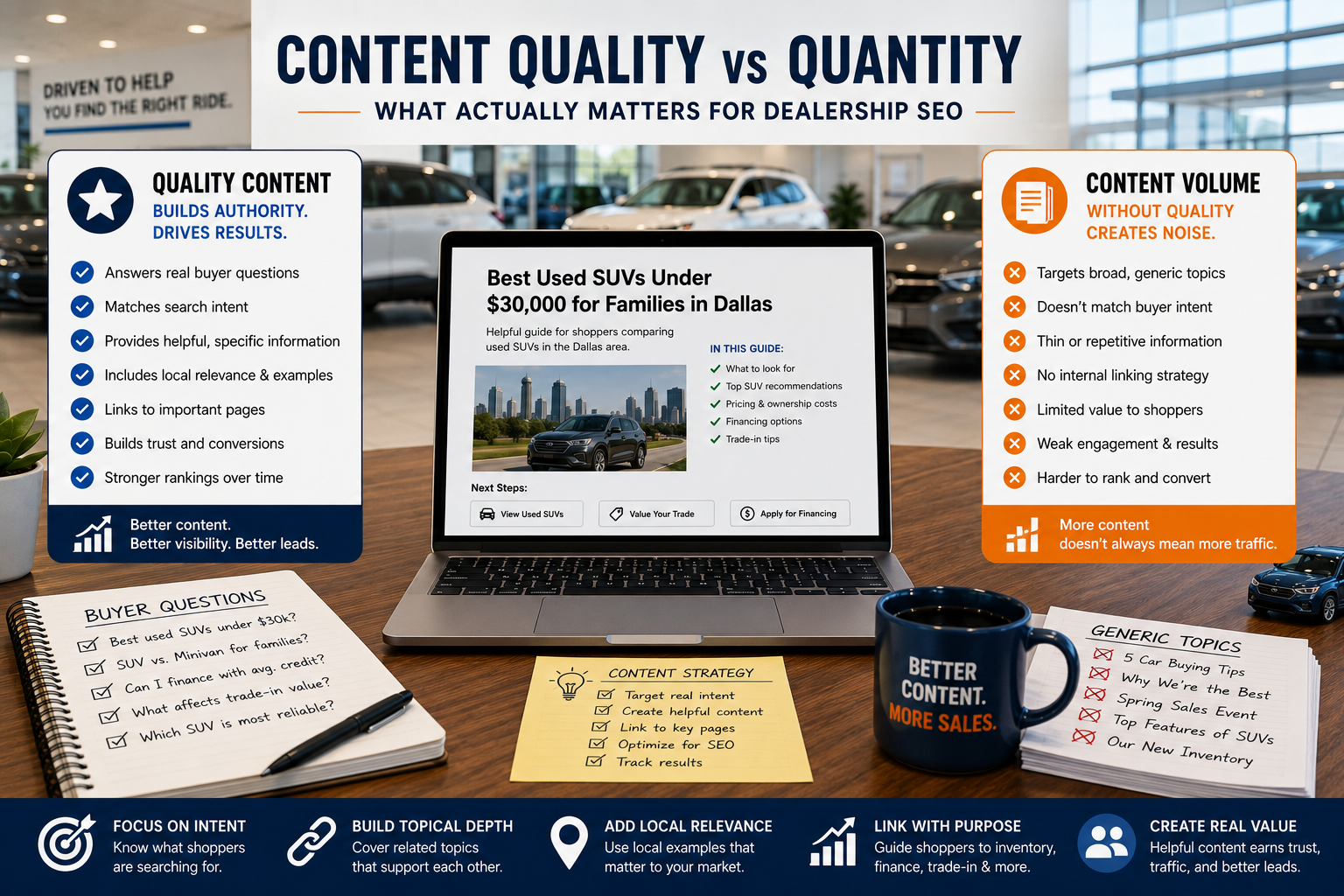
Dealerships often ask the same SEO question:
Should we publish more content, or should we focus on better content?
The honest answer is both, but not equally.
For dealership SEO, quality matters first. Quantity only helps when the content is useful, relevant, and connected to real business goals.
Publishing thirty weak blog posts will not help much if those articles do not answer buyer questions, support inventory pages, or guide shoppers toward finance, trade-in, service, or contact actions.
But publishing one strong article every six months is usually not enough either.
The best dealership SEO strategy balances quality with consistency.
That means creating helpful content on a regular schedule, without filling the website with generic posts that do not serve shoppers or search engines.
Why dealerships get stuck on content quantity
Content quantity is easy to measure.
A dealership can quickly count:
- How many blog posts were published
- How many words were written
- How many topics were covered
- How many pages were added to the website
Because those numbers are visible, they can feel productive.
But more pages do not automatically mean more SEO value.
A dealership in Dallas could publish twenty generic articles like “Top 5 Car Buying Tips” or “Why Visit Our Dealership,” but those posts may not attract real shoppers.
A dealership in Phoenix could publish fewer articles, but make each one focused on real buyer searches like:
- Best used SUVs under $30,000 in Phoenix
- Used truck financing questions buyers should ask
- Honda CR-V vs Toyota RAV4 for daily commuting
- What affects your trade-in value before buying your next vehicle?
The second approach is usually stronger because the content is tied to real search intent.
Quantity only matters when the content deserves to exist.
What quality means in dealership SEO content
Quality does not mean the article sounds fancy.
It does not mean the article is long for the sake of being long.
It does not mean stuffing keywords into every paragraph.
For dealership SEO, quality means the content is useful, specific, accurate, and connected to the shopper journey.
High-quality dealership content usually has these traits:
- It answers a real buyer question
- It targets a clear search intent
- It is specific enough to be useful
- It includes practical examples
- It avoids risky claims
- It links to relevant dealership pages
- It supports inventory, finance, trade-in, service, or location pages
- It is easy to read on mobile
- It has a clear next step
- It can be understood by search engines and AI search tools
Quality content helps both the shopper and the dealership.
That is the standard.
What poor-quality dealership content looks like
Poor-quality content is easy to spot.
It often feels like it could be published on any dealership website in any city.
Examples include:
- Generic holiday announcements
- Thin posts with no real advice
- Articles that repeat the same point several times
- Posts with no internal links
- AI-generated filler with no dealership strategy
- Content that does not connect to inventory or lead pages
- Articles that make unsupported claims
- Posts written only to include keywords
A weak article might have a title like:
“Why Buying a Car Is Exciting”
That topic does not tell us who the article is for, what problem it solves, or what next step it supports.
A stronger article might be:
“Used SUV vs Used Minivan: Which Is Better for Families in Chicago?”
That title is specific. It has clear buyer intent. It supports inventory. It can naturally link to used SUV inventory, used minivan inventory, finance pages, and trade-in tools.
That is the difference.
Why quantity still matters
Quality matters first, but quantity still matters over time.
One good article is helpful.
A library of good articles is more powerful.
Each article can create another entry point into the dealership website.
For example, a dealership that consistently publishes content around used vehicle shopping may eventually cover:
- Used SUVs
- Used trucks
- Used sedans
- Certified pre-owned vehicles
- Trade-ins
- Financing
- Budget-based shopping
- Model comparisons
- Seasonal buying questions
- Local market questions
That creates depth.
Depth helps search engines understand what the website is about.
It also gives shoppers more ways to discover the store before they submit a lead.
The key is that each article should have a purpose.
Quantity without purpose creates clutter.
Quantity with quality creates an SEO asset.
The best content strategy is quality at a consistent pace
Dealerships do not need to publish every day to see value from content.
But they do need consistency.
A practical content schedule might look like:
- One strong article per week
- Two strong articles per month
- Four articles per month for competitive markets
- More frequent publishing for multi-location dealer groups or larger inventory operations
The right publishing pace depends on the dealership’s market, competition, website strength, inventory categories, and SEO goals.
A store in Houston or Los Angeles may need more content depth than a dealer in a smaller market.
A multi-location group in New Jersey, Florida, or Texas may need location-specific content for different markets.
An RV dealer in Orlando may need seasonal content around travel planning, towing, family camping, and trade-ins.
A powersports dealer in Las Vegas may need content around motorcycles, ATVs, side-by-sides, seasonal demand, and financing questions.
Consistency helps build momentum.
But consistency should never become an excuse to publish weak content.
Quality vs quantity comparison
Use this comparison to think about how content approach affects SEO results:
| Content approach | What it looks like | SEO value |
|---|---|---|
| Low quality, low quantity | A few generic posts with no strategy | Very limited value |
| Low quality, high quantity | Many thin articles published often | Can create clutter and weak engagement |
| High quality, low quantity | Helpful articles, but published rarely | Useful, but slow to build momentum |
| High quality, consistent quantity | Helpful articles published on a steady schedule | Strongest long-term approach |
The goal is not simply more content.
The goal is more useful content, published consistently.
How dealerships should decide what to publish
A dealership should not choose blog topics randomly.
Every article should connect to one or more dealership goals.
Before writing, ask:
- Does this topic answer a real shopper question?
- Does it support an inventory category?
- Does it connect to financing, trade-ins, service, or location pages?
- Is there buyer intent behind the search?
- Can the article naturally include internal links?
- Would a salesperson, finance manager, or service advisor recognize this as a real customer question?
- Can the article lead to a next step?
If the answer is no, the topic may not be worth publishing.
For example, “The History of the Automobile” may be interesting, but it probably does not help a dealership generate local buyer traffic.
“Best Used Trucks for Towing in Houston” is more directly connected to shopper intent and inventory.
Why thin content can hurt more than it helps
Thin content is content that does not provide enough useful information.
It may be too short, too generic, copied from another source, or missing real value.
For dealerships, thin content often appears on:
- Blog posts
- Model pages
- Location pages
- Service pages
- Inventory category pages
- Finance pages
Thin blog content can weaken the overall perception of the website.
If a shopper lands on an article and finds nothing useful, they are unlikely to continue.
If search engines find many low-value pages, they may not view the website as especially helpful.
That does not mean every article must be extremely long.
It means every article must satisfy the intent of the topic.
A simple service question may only need a shorter article.
A model comparison or financing guide may need more depth.
Length should follow usefulness.
Content quality also affects conversions
SEO is not only about rankings.
It is also about what happens after the click.
A shopper who lands on a helpful article may continue to:
- Browse inventory
- Start a finance application
- Value a trade
- Schedule service
- Read another article
- Contact the dealership
A shopper who lands on a weak article may leave.
That is why quality matters for conversions.
For example, an article about “What Affects Your Trade-In Value?” should clearly explain mileage, condition, vehicle history, market demand, age, options, and reconditioning needs. It should then link to the dealership’s trade-in appraisal tool.
That article can create a real next step.
A generic article about “Why Trade-Ins Are Great” probably will not.
How AI search changes the quality conversation
AI search tools are making content quality even more important.
Search experiences are becoming more answer-based. Shoppers may see summarized answers before they click. They may also use AI tools to compare vehicles, understand financing, or research dealerships.
Content that is clear, structured, and useful is easier for AI systems and search engines to understand.
That means dealerships should focus on:
- Clear headings
- Direct answers
- Helpful explanations
- Specific examples
- Accurate information
- Safe claims
- Strong internal links
- Useful next steps
Generic filler content is less likely to stand out in this type of search environment.
The better your content answers real questions, the more useful it becomes across both traditional search and AI-assisted discovery.
A practical quality checklist for dealership content
Before publishing a dealership blog article, use this checklist:
- The topic matches a real buyer question
- The title is specific
- The article supports a dealership goal
- The introduction gets to the point quickly
- The headings are clear and helpful
- The content includes practical examples
- The article avoids unsupported claims
- The article links to relevant inventory, finance, trade-in, service, or location pages
- The article has a clear CTA
- The meta title and description are written for search
- The image alt text is descriptive
- The article is easy to read on mobile
- The content does not sound like generic filler
If the article does not pass this checklist, improve it before publishing.
How much content is enough?
There is no perfect number that applies to every dealership.
A small used car dealership may benefit from two strong articles per month.
A franchise store in a competitive city like Miami, Dallas, Atlanta, or Phoenix may need weekly content.
A multi-location dealer group may need a larger content system covering different locations, brands, departments, and inventory categories.
A dealership should think in terms of coverage.
Do you have helpful content for:
- Finance questions?
- Trade-in questions?
- Used inventory categories?
- New vs used vehicle decisions?
- Model comparisons?
- Service questions?
- Local market searches?
- Seasonal demand?
- Budget-based shopping?
- Buyer objections?
If not, there are content gaps.
Those gaps become future article opportunities.
The mistake is choosing one side
Some dealerships publish too much content without caring whether it is useful.
Others overthink quality so much that they rarely publish anything.
Both approaches have problems.
The better approach is to create a repeatable content system.
That system should produce articles that are:
- Helpful
- Specific
- Consistent
- Internally linked
- Locally relevant where appropriate
- Connected to dealership goals
This is where automation can help, but only if the automation is built around dealership-specific strategy.
Automated content that creates generic filler is not the answer.
Automated content that turns buyer questions into useful, SEO-focused dealership articles can be valuable.
Final thoughts
For dealership SEO, quality matters more than quantity.
But consistency still matters.
The winning strategy is not publishing as much as possible. It is publishing useful content on a steady schedule.
A dealership blog should help real shoppers make better decisions. It should support inventory, finance, trade-in, service, and location pages. It should answer questions your team already hears from buyers every week.
When quality and consistency work together, blog content becomes more than a marketing task.
It becomes a long-term SEO asset.
Suggested internal links for this article
Link this article to the following pages on your dealership website:
- Why Blog Content Still Matters for Car Dealership SEO
- How to Turn Buyer Questions Into Dealership Website Traffic
- Writing Content That Ranks for Dealerships: A Practical Guide
- The Dealership Content Strategy Most Stores Are Missing
- What Are Buyer-Intent Keywords for Car Dealerships?
- How Blog Articles Should Link to Inventory, Finance, and Trade-In Pages
Related articles
Why Blog Content Still Matters for Car Dealership SEO
Blog content still matters for car dealership SEO when it answers buyer questions, supports inventory pages, and helps dealers appear in Google and AI search.
Jul 4, 2026 · 7 minDealer SEOSEO for Auto Service Shops: How Content Brings in More Service Customers
How automotive SEO services and smart content help auto service shops attract more local repair customers and steady shop bookings.
Sep 6, 2026 · 8 minDealer SEOSEO for Trailer Dealers: Local Content That Drives Buyer Leads
Practical trailer dealer SEO tactics to publish local content, rank for buyer searches, and turn clicks into calls, form fills, and walk-ins.
Sep 5, 2026 · 8 minDealer Blogs helps dealerships create consistent, SEO-focused articles that answer buyer questions, support inventory and finance pages, and improve visibility in Google and AI search.