
How Multi-Location Dealerships Should Approach SEO Content
A practical playbook for multi-location dealers to structure pages, content, and reviews so each store ranks locally and wins market share with content that scales.
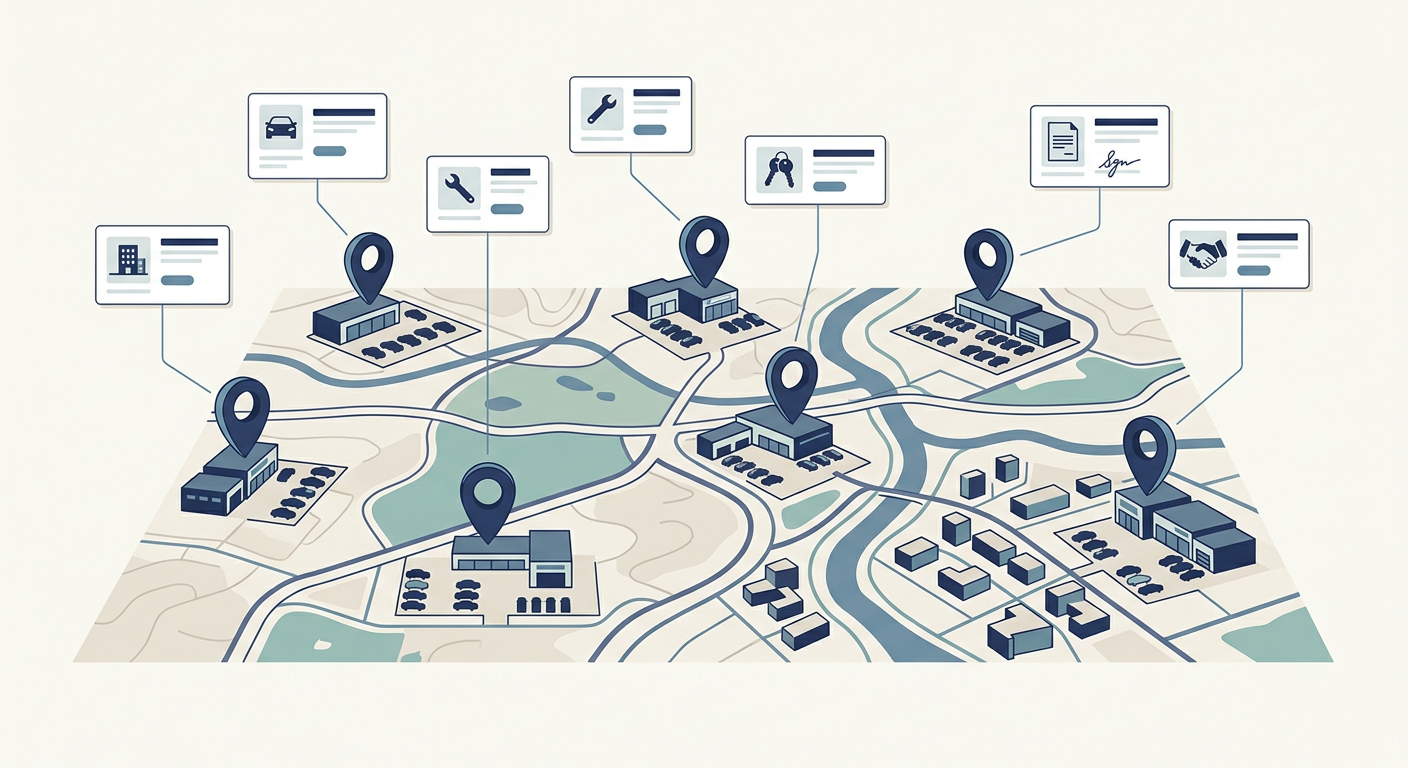
Running one store is one thing. Running five across different cities is another.
Your teams, inventory, and local markets are not the same. Your SEO shouldn’t be either.
Here’s how to scale local SEO for dealerships across multiple rooftops without creating chaos.
The goal: a structure that lets every store rank for its city while sharing what works across the group.
Why local SEO for dealerships gets trickier with multiple rooftops
Local SEO depends on proximity, relevance, and prominence. With multiple locations, proximity is on your side—but only if each store has its own local signals.
You need location-specific pages, content, reviews, and structured data that map to each market. Otherwise, your brand competes with itself and dilutes local relevance.
This isn’t just about car sales. It includes service, parts, and body shop visibility per market, too.
Start with a durable site structure
You have three common options for multi-location architecture. Pick one and commit so content doesn’t drift.
- Single brand domain with subfolders per location (example: /locations/city-dealership)
- Single brand domain with a location hub and child pages (example: /city/ and /city/service/)
- Separate domains per store (only if mandated by OEM or legacy constraints)
Most groups succeed with one primary domain and clean subfolders. It concentrates authority and is easier to manage at scale.
If you’re mapping this for an auto group, review the fundamentals in Car Dealership SEO and adapt them store by store.
One Google Business Profile per store, aligned with pages
Each physical location needs its own profile, address, phone, hours, categories, and photos. Consistency matters.
Map every profile to a unique location page. Don’t point every profile to your homepage.
- Each store gets: name, address, phone (tracking optional with hardline displayed), hours, categories, services
- Link to the correct location page (sales or service as appropriate)
- Use local photos, posts, and UTM-tagged URLs for measurement
Build city-focused location pages that actually solve problems
A location page should do more than list an address. It should help a shopper in that city complete the next step.
- Clear headline: City + dealership type (e.g., car, RV, motorcycle)
- Primary CTAs: call, directions, browse inventory, schedule service
- Embedded map, parking tips, and nearby landmarks
- Localized copy that references the city and nearby suburbs, without stuffing
- Featured inventory or services most in demand in that market
- Unique FAQs about that store’s policies, fees, and process
Write a unique 250–400 words for each location page. Then extend with child pages for Sales, Service, Parts, and Financing specific to that store.
A scalable site structure for local SEO for dealerships
Think in hubs. Each city becomes a hub with supporting pages that answer common local searches.
- /city/ — The city hub
- /city/sales/ — Sales overview
- /city/service/ — Service overview
- /city/parts/ — Parts overview
- /city/financing/ — Financing overview
- /city/reviews/ — Store reviews and reputation
Mirror the structure across locations, but keep the copy, imagery, and internal links unique to each store.
Sales and service content: two funnels, two calendars
Sales and service search intent is different. Treat them like separate funnels for every store.
- Sales: inventory categories (SUVs, trucks, EVs), model comparisons, trade-in, delivery, local credit and first-time buyer guides
- Service: maintenance schedules, seasonal tire changes, recalls, diagnostics, brakes, oil changes, alignment, and city-specific driving conditions
Service keywords are bottom-funnel and very local. Build them per store and connect them to your store’s Google Business Profile landing page.
If you need a deeper playbook for fixed ops, start with Fixed Operations SEO and apply it to each rooftop.
Inventory and specials, localized by market
Shoppers in one city won’t always want the same mix as another. Reflect real demand.
- Feature popular body styles or segments by market
- Create local specials pages per store (even if offers are similar)
- Add internal links from specials to relevant service or sales pages
- Use local proof: recent deliveries, customer photos, community events
Avoid copying the same “Sales Event” text across all cities. Small changes and local references help both conversion and relevance.
Avoid duplicate content with a simple template system
Uniform structure is good. Identical copy across cities is not.
- Draft one master outline per page type
- Swap in city, neighborhood, and store-specific details
- Add unique FAQs and service highlights per store
- Use distinct images and staff bios for each location
Treat every block of copy as an opportunity to localize. Even 20–30% unique content can make a difference across near-duplicate templates.
Centralized vs location-led content: pick your operating model
Use this to decide who writes and who reviews.
| Approach | Pros | Cons | When it fits |
|---|---|---|---|
| Centralized team | Consistent quality, faster rollout, shared SEO strategy | Risk of generic copy, slower to capture local nuance | New content program, limited store bandwidth |
| Location-led with central QA | Authentic local insights, stronger community relevance | Requires training, can drift from standards | Mature program, strong store managers |
| Hybrid by funnel (central sales, local service) | Balances scale and nuance | Coordination overhead | Groups with strong fixed ops leaders |
Whatever you choose, establish a content brief per page type and a QA checklist everyone follows.
Internal linking that reinforces local relevance
Keep city content in its city hub. Interlink location pages only when helpful to the shopper.
- From city hub to: sales, service, parts, financing, reviews
- From service pages to related services (brakes → alignment)
- From local blogs to the nearest store’s hub and service pages
- From corporate pages to a store finder, not to a random store
Avoid creating dozens of cross-city links just to pass authority. It dilutes signals and confuses users.
Local blogs that support each city hub
Blogs are where you scale topical relevance without bloating landing pages.
- Seasonal content: winter tire tips for Denver, summer towing tips for Phoenix
- Local buyer guides: best used SUVs under $20k in Tampa (without quoting price guarantees)
- Ownership topics: EV charging around Austin, boat winterization near Syracuse
- Event recaps: local shows, charity drives, trail cleanups
Publish 2–4 local blog posts per store per month and link them back to the city hub and relevant service pages.
If you’re tight on bandwidth, consider a platform built for dealership content at scale like Dealership SEO Software.
Using automation and AI without losing the local touch
Automation helps with calendars, briefs, and templates. Your team adds the geographic nuance and store voice.
- Generate topic clusters by city and department
- Pre-fill outlines with local neighborhoods and landmarks
- Insert structured data, hours, and phone automatically
- Keep human editors for accuracy and brand tone
If you’re evaluating tools, see how we approach it in AI SEO for Car Dealerships and decide what to automate versus keep in-house.
Reputation and reviews at the store level
Reviews are a top local signal and a conversion asset. Encourage them store by store.
- Train advisors and salespeople to ask at the right moment
- Respond to every review with location-aware context
- Feature reviews on each city hub and related service pages
- Use UTM links from profiles to track review traffic
Keep photos, Q&A, and attributes current on each profile so customers recognize the store when they arrive.
On-page essentials for every location page
Hit the basics so search engines and shoppers trust the page.
- Title: City + dealership type + brand where applicable
- H1: City + core offer (sales or service)
- Meta description: local CTA and proof points
- NAP block: name, address, phone, hours as crawlable text
- Embedded map, directions, parking tips
- Local schema (Organization + LocalBusiness variant) per store
Use compression on images and a lean template so pages load quickly on mobile networks.
A simple analytics plan for multi-location reporting
Measure at the store level so you can reallocate effort to what works.
- Track calls, directions, and form fills per store
- Use UTM-tagged links from each profile to the matching page
- Segment organic traffic by location folders
- Monitor keywords that include city names and service terms
Build a monthly scorecard by store: impressions, clicks, conversions, and the pages that drove them.
Common pitfalls that hurt multi-location visibility
These issues cost rankings and leads, and they’re avoidable.
- All profiles pointing to the homepage
- Identical copy across all city pages
- One global phone number instead of store lines
- Thin service content per location
- Cross-city link spam to “share authority”
- No review management process per store
Fixing these often lifts the entire group’s local visibility within weeks as search engines see clearer signals.
A 90-day rollout plan you can actually execute
Start with structure, then scale content, then optimize.
- Days 1–15: finalize site architecture and location page templates; map each profile to its page
- Days 16–45: publish or refresh all city hubs and core department pages per store
- Days 46–75: launch local blog cadence and specials pages per store
- Days 76–90: review analytics, tighten internal links, fill content gaps
Keep momentum by assigning owners per store and one central editor for QA.
How this differs across verticals
The structure is similar, but demand and seasonality differ by category.
- Auto: model research and certified pre-owned demand is high
- RV and marine: strong seasonality and trip-planning content
- Powersports and motorcycle: trails, routes, events, and seasonal service
- Trailer and equipment: business use cases, financing docs, uptime-focused service
See vertical specifics and adapt your local hubs accordingly.
Content ops: in-house, agency, or software?
Do a realistic bandwidth check before you promise weekly city posts for every store.
Some groups blend internal talent with software and selective partners. If you’re weighing options, here’s a practical comparison of Dealer Blogs vs SEO Agency to help you decide.
If you want a repeatable system that publishes on-brand local posts at scale, explore our Dealership SEO Software.
Budgeting and resourcing across the group
Tie budget to store opportunity, not just store size.
- Allocate baseline content for every store (city hub + two service pages + two blogs/month)
- Add budget for stores in competitive metros or with growth targets
- Share learnings and templates group-wide to lower unit costs
Set quarterly goals and review them alongside sales and service KPIs.
Bringing it together: local seo for dealerships at scale
Your framework is simple: clear architecture, unique local content, matched profiles, and disciplined measurement.
Use automation for the mechanical parts and save human effort for local nuance and store voice. That’s how multi-location organizations win local SERPs consistently.
When you’re ready to operationalize, compare tools and plans, and choose a cadence you can sustain. Our plans are transparent on pricing so you can right-size the program.
Final thoughts
Multi-location success in local SEO is a systems problem, not a luck problem.
Build a repeatable structure, keep every store’s signals clean and unique, and publish helpful local content on a steady cadence.
With the right mix of templates, automation, and store-level input, each rooftop can earn visibility in its city and lift the brand across the region.
If you want to move faster, explore Car Dealership SEO for fundamentals and use software like Dealership SEO Software to scale the work.
Related resources
- Car Dealership SEO — Fundamentals you can apply per store.
- Fixed Operations SEO — Build service visibility for each rooftop.
- Dealership SEO Software — Automate local content at scale.
- Dealer Blogs vs SEO Agency — Pick the right operating model.
- The Most Effective Local SEO Strategies for Car Dealerships in US Cities — City playbook ideas.
- How a US Car Dealership Can Set Up Automated SEO to Generate More Local Leads — Automation setup walkthrough.
Related articles
Why Dealership Location Pages Need Supporting Content
Location pages rarely rank on their own. Learn how supporting content lifts visibility, traffic, and leads across every city you serve.
Aug 4, 2026 · 8 minLocal SEOAutomotive Local SEO: How Google Picks Which Dealership to Show
Wonder why a competitor shows up in the Map Pack instead of you? Here’s how automotive local SEO actually works and what your dealership can adjust.
Sep 30, 2026 · 9 min read.Local SEOLocal SEO for Car Dealerships: Covering the Towns Around You
Your market isn’t just one city. Use local SEO for car dealerships to cover nearby towns, drive map rankings, and pull shoppers from every direction.
Sep 29, 2026 · 9 min read.Dealer Blogs builds and publishes city-specific sales and service content across all your rooftops—on schedule and on brand. See how it scales without extra headcount.