
Automotive Dealer SEO: A Complete Guide for Franchise and Independent Stores
A practical, dealership-first guide to automotive dealer SEO for franchise and independent stores, with tactics, KPIs, and a 90-day plan to win local search.
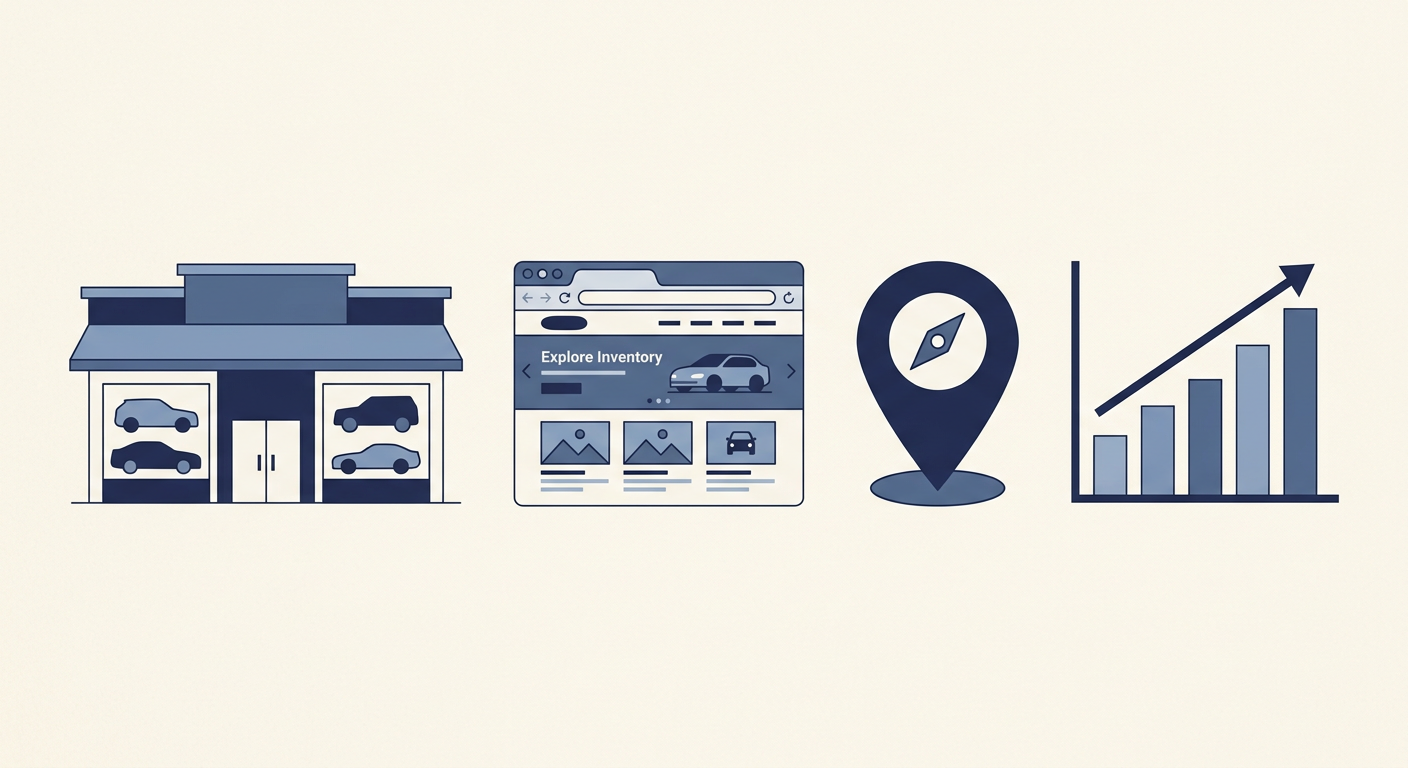
Your market is crowded. Paid ads are expensive. Inventory changes weekly.
Automotive dealer SEO gives you a steady pipeline of shoppers who are already searching for what you sell.
Here’s how franchise and independent dealers can build an SEO program that actually moves the needle.
What is automotive dealer SEO?
Automotive dealer SEO is how your store earns visibility in local search for high-intent queries—make/model research, service terms, trade-in questions, and brand comparisons—without relying only on paid ads.
It blends local SEO, content strategy, on-page optimization, and technical hygiene so your inventory, service pages, and blogs capture buyers at every stage.
If you need a deeper vertical overview, this primer on car dealership SEO lays out how franchise and independent auto retailers build topical authority in their market.
Franchise vs. independent: how strategies differ
Franchise dealers ride on OEM demand and model-specific searches. Independent used-car stores compete on broader shopping terms, finance questions, and availability.
Both need a strong local footprint, but the content mix changes based on your inventory control and brand leverage.
- Franchise focus: new model research, model-year changes, trim comparisons, certified pre-owned FAQs, recall and warranty education.
- Independent focus: make-agnostic shopping guides, price bracket content, trade-in and credit questions, ownership tips that fit popular local vehicles.
- Shared focus: service and maintenance, tires, alignments, brakes, seasonal driving, and local buyer education.
Automotive dealer SEO fundamentals that don’t change
No matter your store type, three things win: topical depth, local relevance, and consistency.
That means mapping keywords to buyer journeys, publishing helpful content weekly, and aligning every page with a clear internal-link path to conversions.
- Topical depth: multiple articles and pages around each theme (e.g., SUVs, winter tires, hybrid maintenance) that interlink.
- Local relevance: service area pages, directions, FAQs with neighborhood names, and real photos.
- Consistency: new content and updates every month to match shifting demand and inventory.
Build pages around buyer intent, not just keywords
Searchers have jobs to be done: research, compare, locate, evaluate, and decide.
Match page types to those intents so shoppers move naturally through your site.
- Research: model overviews, "vs" comparisons, trim explainers, ownership costs.
- Compare: side-by-side specs, cargo space, towing, fuel economy, features by trim.
- Locate: inventory and service area pages with directions and hours.
- Evaluate: reviews, customer stories, certification checks, inspection processes.
- Decide: trade-in, finance education, appointment and test drive CTAs.
Automotive dealer SEO: on-page basics that compound
Get the page-level details right, then scale with repeatable templates.
- Titles and H1s: lead with intent, include make/model or service, and your city.
- Meta descriptions: persuasive summaries that earn clicks—clear, benefit-led.
- Headers (H2/H3): structure content to answer questions fast.
- Schema: Organization, LocalBusiness, Product/Vehicle, and FAQ where relevant.
- Images: descriptive alt text (model, angle, feature), compressed for speed.
Internal linking and site architecture
Internal links route equity from high-traffic content to inventory, fixed ops, and conversion pages.
Keep a clean structure: homepage → category hubs → subpages → blogs, with clear paths back to inventory and service.
For a deeper walkthrough, see why strategic linking improves crawl and conversions in Why Internal Linking Matters for Dealership SEO.
Local SEO: GBP, reviews, and service area coverage
Your Google Business Profile (GBP) and reviews influence map pack rankings and click-through.
- GBP: accurate hours, categories, services, products (tires, oil change), photos, and weekly posts.
- Reviews: steady, recent, and specific—respond to all with helpful, professional tone.
- Service area pages: unique content per city or neighborhood with local proof (landmarks, weather, traffic patterns).
Inventory pages vs. supporting content
Inventory results fluctuate with supply and seasonality. Support them with evergreen content that attracts research-phase shoppers and directs them to your VDPs.
- Model research posts that link to current VDPs.
- Buyer’s guides by body style and budget.
- Trade-in and financing education that funnels to appraisal and credit pages.
Content types that consistently win in automotive SEO
These formats bring qualified traffic and assist conversions year-round.
- Model overviews and trim breakdowns.
- "Model A vs Model B" comparisons.
- Best-of lists by price, size, towing, or range.
- Maintenance and ownership schedules.
- Seasonal prep and local driving tips.
- Trade-in, equity, and payment education.
- Fixed ops FAQs that match common service questions.
Optimize for fixed operations
Service, parts, and body shop content fills the gap between inventory cycles and stabilizes organic traffic.
If your goal is year-round demand capture, build a dedicated fixed ops content plan and interlink it to your main hubs. For more detail, see our approach to fixed operations SEO.
Technical SEO for dealership websites
Don’t let basic site issues block results.
- Core Web Vitals: compress images, lazy-load galleries, minimize render-blocking scripts.
- Crawl budget: noindex thin tag pages, facet combinations, and test environments.
- Canonicals: avoid duplicate model pages across trims or cities.
- Sitemaps: include inventory, service, and blogs—refresh frequently.
- 404/redirects: keep model-year transitions tidy and preserve equity.
E-E-A-T for dealerships: trust signals that matter
Demonstrate experience, expertise, and trustworthiness on every page.
- Author and reviewer bios tied to your team (service manager, sales lead).
- Real photos and video walkarounds.
- Transparent processes: inspections, reconditioning, certification steps.
- Clear policies: appointments, returns/exchanges (if applicable), and contact points.
Measure what matters: KPIs for automotive dealer SEO
Traffic is a proxy. Track outcomes that map to leads and sales.
- Non-brand clicks from your service area.
- Rankings for priority research and service terms.
- Assisted conversions from blogs to inventory and forms.
- Calls, chats, directions, and form fills from organic sessions.
- Index coverage and crawl health.
Automotive dealer SEO for franchise vs. independent priorities
Your editorial calendar and internal links should reflect how your store attracts demand.
- Franchise: new model launches, mid-cycle refreshes, trim content, OEM accessories, recall guidance, CPO education.
- Independent: price brackets, "best used" lists, inspection standards, vehicle history education, flexible financing FAQs.
- Both: seasonal maintenance, tire and brake content, service packages, and local event tie-ins.
The publishing cadence that works
Consistency outranks sporadic bursts. Aim for a realistic, repeatable schedule.
- 1–2 research articles weekly tied to current inventory priorities.
- 1 fixed ops article weekly to stabilize traffic.
- Monthly updates to top performers with fresh links to current VDPs.
- Quarterly pruning and consolidation of thin or redundant posts.
Agency vs. software vs. in-house for automotive dealer SEO
Different teams win in different situations. Choose for control, speed, and repeatability—not vanity metrics.
Here’s a quick comparison to help you pick the right model for your store.
| Approach | What you control | Pros | Watch-outs | Best fit |
|---|---|---|---|---|
| Agency | Strategy and reporting cadence | Hands-off execution, expertise on call | Variable quality, slower content velocity, long contracts | Dealers without marketing staff |
| Software | Calendar, topics, approvals | Scales content fast, lower cost per article, consistent templates | Requires initial setup and QA | Dealers wanting steady publishing |
| In-house | Everything, end to end | Full control, brand voice | Hiring, training, slower output, higher fixed costs | Groups with a central marketing team |
If you’re weighing your options, compare models and outcomes in Dealer Blogs vs SEO Agency so you can choose the path that fits your resources and goals.
Topic research: where good ideas come from
Let the market tell you what to write, then localize.
- Autocomplete and People Also Ask questions adapted to your city and brands.
- Service advisor and BDC logs—turn repeat questions into articles.
- Sales team insights—trade-in objections, trim confusions, feature comparisons.
- Seasonality—winter tires, road salt, towing season, road trip checklists.
On-page templates you can reuse
Standardize how you cover common topics so your team ships faster and more consistently.
- Model overview template: key specs, trims, features, comparisons, local availability.
- Service FAQ template: symptoms, intervals, costs range (no specific quotes), why it matters, booking CTA.
- Best-of list template: selection criteria, 5–7 picks, pros/cons, what to consider, links to VDPs if available.
Internal linking playbook
Every research page should push equity and users to inventory, service, and conversion pages.
- From model overviews → matching VDPs and category SRPs.
- From "vs" comparisons → both model hubs and current stock.
- From seasonal service tips → schedule, parts, and tire pages.
- From trade-in education → appraisal tool and valuation pages.
Image, video, and media that support rankings
Media helps win clicks and time on page. Keep it lean and useful.
- Real photos of your lot and service bays; compress to under 200KB when possible.
- Short video walkarounds with chapters and descriptive filenames.
- Diagrams for towing, cargo, and seating—help people visualize the decision.
Updating and consolidating content
Old content can become new wins with a structured refresh.
- Re-title around current trends and city names.
- Replace outdated model info with latest specs.
- Add links to current inventory and core service pages.
- Merge thin pages into a stronger hub and redirect the rest.
Automotive SEO pitfalls to avoid
These common missteps waste crawl budget and confuse buyers.
- Thin doorway pages for every suburb with no unique value.
- Duplicate model pages across multiple URLs.
- Over-reliance on inventory feeds without supporting content.
- Ignoring service content because "sales matter more"—they both feed the funnel.
- Publishing without internal links or CTAs.
A 90-day plan to kickstart automotive dealer SEO
Make progress in quarters. Here’s a simple path.
- Weeks 1–2: audit technical issues, map priority topics, set KPIs.
- Weeks 3–6: publish 2–3 articles weekly (1 research, 1 fixed ops), add internal links, update top 5 pages.
- Weeks 7–10: add comparison content and local service area pages, request reviews, optimize GBP.
- Weeks 11–12: measure outcomes, prune or merge underperformers, plan next quarter.
Scaling production without burning out your team
Templates, topic libraries, and software let you keep quality high while shipping more.
If you want predictable output and control over topics and approvals, see how a purpose-built platform streamlines calendars, briefs, and edits with dealership SEO software.
How AI fits into dealership marketing
AI accelerates research and drafting, but it needs guardrails: real data, local proof, and editor review.
Used well, it saves time on outlines, FAQs, and internal linking while your team adds expertise, media, and brand tone. Learn how we combine AI with editorial standards in AI SEO for Car Dealerships.
Tie content to real business goals
Every article should point to an action: view inventory, book service, get an appraisal, or contact your team.
- Primary CTAs: view VDPs/SRPs, schedule service, request appraisal.
- Secondary CTAs: download a checklist, watch a walkaround, read buyer’s guides.
- Always include location, hours, and directions on high-traffic pages.
When to expand beyond cars
If your group spans RV, powersports, motorcycle, marine, trailer, or equipment, replicate the same playbook with localized topics and fixed ops content for each vertical.
- Start with the highest-margin or most seasonal department.
- Build a small topical hub first, measure lift, then scale.
- Reuse frameworks—change the examples and local proof.
Content quality checklist before you publish
Run each draft through a quick scoreboard.
- Does it answer the query fully and quickly?
- Are the examples local to your market?
- Are there 2–4 internal links to relevant pages?
- Are media compressed and labeled?
- Is there a clear, single primary CTA?
Reporting rhythm that keeps teams aligned
Short, frequent check-ins beat long, infrequent recaps.
- Weekly: top pages, new rankings, issues found, next priorities.
- Monthly: assisted conversions, GBP actions, review velocity, content velocity.
- Quarterly: topic expansion, pruning, and investment shifts based on ROI.
Bring it all together with a simple workflow
Plan topics, assign drafts, review, publish, link—then repeat. Document each step so anyone on your team can ship confidently.
If you’re ready to turn a plan into output, explore packages and examples on our pricing page and choose a cadence that fits your goals and headcount.
Final thoughts
Automotive dealer SEO isn’t a one-time project. It’s an operating system for steady, high-intent traffic and calls.
Focus on topics that match buyer intent, publish consistently, interlink to the pages that sell, and protect your technical foundation.
Do that quarter after quarter, and you’ll build durable visibility that keeps working even when ad costs spike or inventory shifts.
Related resources
- Car Dealership SEO — Overview of local and content strategy for franchise and independent auto dealers.
- Fixed Operations SEO — How to build year-round demand with service, parts, and body shop content.
- Dealership SEO Software — Automate topic planning, writing, and publishing with dealer-ready templates.
- Dealer Blogs vs SEO Agency — Compare delivery models and outcomes before you commit budget.
- SEO for Car Dealerships: The Content Playbook That Actually Works in 2026 — Step-by-step content engine.
- Why Internal Linking Matters for Dealership SEO — Structure and linking that lift rankings and conversions.
Related articles
What to Look For in an Automotive SEO Company
Shopping for an automotive SEO company? Here’s how to vet services, pricing, reporting, and fit so your dealership gets real search traffic and leads.
Sep 25, 2026 · 8 min read.SEO StrategyAuto Dealer SEO: Why Inventory Pages Alone Never Hold Rankings
Relying on SRPs and VDPs is why your rankings bounce. Here’s a practical auto dealer SEO playbook that builds durable traffic beyond inventory pages.
Sep 28, 2026 · 9 min read.SEO StrategyDealership SEO Services: What You Should Actually Be Paying For
Tired of vague SEO packages? Here’s what dealership SEO services should actually include, what to skip, and how to budget your monthly retainer.
Sep 27, 2026 · 9 min read.Dealer Blogs plans, writes, and publishes SEO content for your dealership on a reliable cadence, with internal links that support inventory and fixed ops.