
Automated SEO vs Manual SEO for US Auto Dealers: Cost and Effectiveness
Compare automated SEO vs manual SEO for US auto dealers. See how costs, time, and outcomes differ, and learn when each approach is most effective for your store.
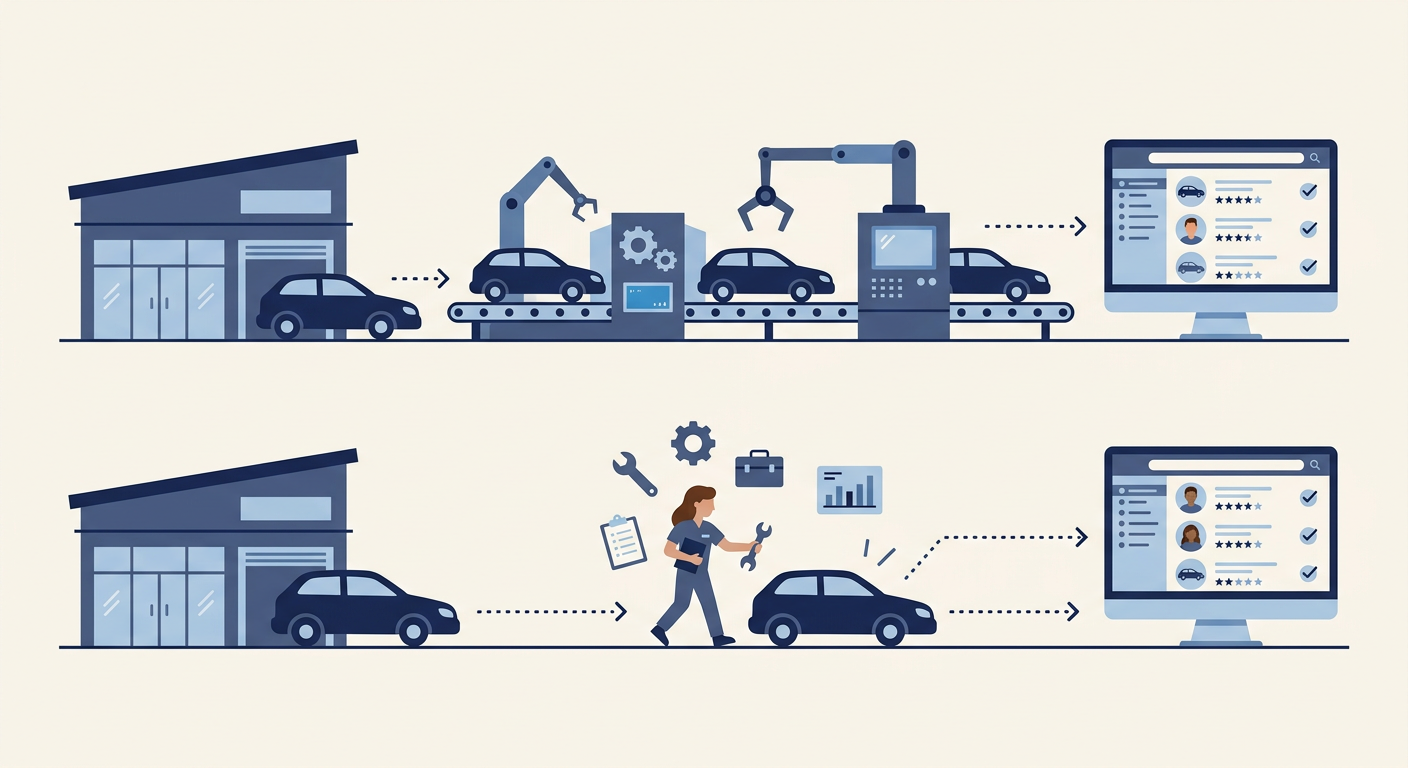
Automated SEO vs manual SEO is the question a lot of US auto dealers are asking right now.
You need more qualified organic traffic, but you also need to control costs and staff bandwidth.
Here’s a practical breakdown of cost, effort, and dealership SEO effectiveness—so you can choose a mix that actually fits your store.
Automated SEO vs manual SEO: what it really means
Automated SEO uses software to systematize research, content creation, publishing, internal linking, and reporting. It’s about repeatable processes that scale across models, trims, and locations.
Manual SEO relies on hands-on specialists. They perform research, write content, optimize pages, and build links by hand. It offers full control but is slower and costlier per page.
- Automated SEO: templates, AI-assisted drafting, programmatic internal links, scheduled publishing, dashboards.
- Manual SEO: deep research, custom copywriting, bespoke on-page edits, selective link building, one-off technical fixes.
For many dealers, the best results come from a hybrid—automating routine content and cadence while reserving expert time for strategy and high-impact pages. A platform like Dealership SEO Software can handle the heavy lifting while your team steers priorities.
How US auto dealers tackle SEO today
Most stores have more SEO needs than hours in the week. Between inventory, specials, service, and local content, it’s easy to fall behind on publishing.
Franchise and independent stores alike need a repeatable plan. If you’re just getting started, this high-level view of car dealership SEO explains how local ranking factors and content work together.
- Common blockers: content bottlenecks, inconsistent publishing cadence, thin location pages, duplicate OEM content, limited internal links, and no clear reporting loop.
Cost breakdown: time, tools, and headcount
Think of auto dealer SEO cost as an equation of time, tools, and talent. Each lever changes your monthly spend and output.
- Time: research, writing, editing, uploading, internal linking, image prep, metadata, QA.
- Tools: keyword research, content briefs, AI assistance, CMS plugins, analytics, dashboards.
- Talent: strategist, writer, editor, SEO lead, developer support (as needed).
Manual SEO is flexible but adds cost with each new page. Automation reduces marginal cost per page as you scale, but you still need oversight.
Dealership SEO effectiveness: what actually moves the needle
Effectiveness comes from matching buyer intent with consistent, useful content. Algorithms reward pages that answer local questions well, load fast, and are easy to navigate.
- Coverage: enough content to match your brand mix, trims, and local search demand.
- Quality: helpful, specific copy that avoids thin or duplicate content.
- Intent: topics that map to research, comparison, and local transactional queries.
- Cadence: publishing new and refreshed content every month.
- Structure: smart internal links that connect blogs to VDPs, services, and location pages.
Automation can help you hit coverage and cadence. If you’re curious how AI fits into this, see how we approach it in AI SEO for Car Dealerships.
Speed and consistency: your content cadence
Search visibility compounds as you publish consistently. Slow, sporadic output makes it hard to outrank local competitors.
- Automated workflows keep a steady schedule month after month.
- Manual-only workflows often slow down when staff shift to sales events or inventory pushes.
- Consistency is a signal—both to shoppers and to search engines.
The faster you get from idea to published page (without sacrificing quality), the faster you learn and improve.
Scalability across brands, trims, and cities
Dealers don’t need just one article—they need dozens that map to popular models, seasonal topics, service needs, and local terms.
Automation shines when you need structured content at scale, especially across multiple rooftops or metro areas. Manual-only approaches often struggle to keep up.
- Watch-outs: avoid templated content that reads generic, ensure city modifiers make sense, and localize with real dealership details and assets.
Control, voice, and quality assurance
Manual SEO gives you granular control over messaging and tone. Automation needs guardrails to protect brand voice and accuracy.
- Insist on editorial review workflows and final approval controls.
- Require unique copy and strong fact-checking for local specifics.
- Keep a style guide to maintain consistency across automated and manual content.
Blending both is often ideal: automation drafts and structures; humans refine, approve, and localize.
Data, feedback loops, and updates
Effectiveness depends on learning from your data. The goal isn’t just publishing—it’s iterating.
- Track: impressions, clicks, rankings, conversions, and assisted conversions.
- Act: update content that rises, fix pages that stall, expand topics that show momentum.
- Refresh: modernize posts with new models, trims, pricing context, and internal links.
This is where automation and dashboards help. If you’re comparing vendors, also weigh control and service model—see Dealer Blogs vs SEO Agency for how workflows differ.
When manual SEO wins
Manual work is the better tool when you need high-stakes precision.
- Major site restructures or technical fixes.
- Flagship model pages and core service pages.
- Sensitive brand messaging and compliance.
- Complex comparison content for niche buyers.
When automated SEO wins
Automation is the better tool when you need consistent volume and coverage.
- Blog content for common buyer questions across models and seasons.
- Location and service content that follows a proven structure.
- Internal linking at scale to support VDPs and category pages.
- Ongoing refreshes and metadata updates across many posts.
Automated SEO vs manual SEO: where each shines
Think of it like your showroom and service lane. Some jobs need master techs. Others need reliable processes that run every day. Use both to win your market.
Compare automated SEO vs manual SEO at a glance
| Factor | Automated SEO | Manual SEO |
|---|---|---|
| Cost per page at scale | Decreases as volume grows | Increases with each new page |
| Speed to publish | Fast, scheduled | Slower, dependent on staff time |
| Consistency | High | Varies with workload |
| Scalability | Strong across models and locations | Limited without more headcount |
| Control/voice | Needs guardrails and review | Full editorial control |
| Quality assurance | Systematic checks + human review | Human-led checks |
| Data feedback | Built-in dashboards and iteration | Manual reporting and analysis |
| Best for | Coverage, cadence, refreshes | Flagship pages, complex topics |
Budgeting and ROI timelines
SEO is a compounding channel. You’re building durable visibility that lowers blended acquisition cost over time.
- Budget for a baseline cadence you can sustain for 6–12 months.
- Phase manual efforts into the highest-impact pages first.
- Use automation to fill gaps, support seasonality, and maintain refresh cycles.
Not sure how different plans compare? See our overview of dealership SEO pricing to understand how scope changes cost.
Implementation checklist for your store
- Define goals: organic leads, service bookings, model awareness, or market share.
- Map topics: models, trims, seasonal, service, local dealership queries.
- Choose cadence: monthly output targets for new and refreshed content.
- Set QA: style guide, brand voice, approval workflows, compliance checks.
- Connect data: analytics, conversions, and call tracking to content.
- Plan internal links: connect blogs to VDPs, SRPs, services, and location pages.
- Schedule reviews: quarterly audits to update winners and fix laggards.
Bring stakeholders in early. Sales, service, and marketing each have insights you can turn into topics and proof points.
How Dealer Blogs fits into your plan
Dealer Blogs automates the heavy lifting—topic research, drafting, internal linking, publishing cadence, and reporting—while keeping you in control of approvals and voice. If you want to see how this could work at your dealership, explore plans on our pricing page.
Onboarding is straightforward: we align on topics, tone, cadence, and approval rules. Then content starts publishing on schedule—freeing your team to focus on strategy and store operations.
Final thoughts
You don’t have to choose sides in the automated SEO vs manual SEO debate. Use automation for scale and consistency, and apply expert manual attention where nuance and impact are highest.
That mix keeps costs predictable, content flowing, and results improving—month after month—without overloading your team.
Related resources
- Dealership SEO Software — See how automated content publishing works for dealers.
- AI SEO for Car Dealerships — How we use AI with editorial oversight.
- Dealer Blogs vs SEO Agency — Compare workflows, costs, and control.
- Dealership SEO Pricing — Understand scope and pricing options.
- What Is Automated SEO for Car Dealerships? — A deeper dive into automation.
- Car Dealership SEO — Local SEO fundamentals for franchise and independent stores.
Related articles
Automated SEO vs Manual SEO for Canadian Auto Dealers: Cost and Effectiveness
Weighing automated vs manual SEO for your Canadian dealership? Here’s a practical look at cost, effectiveness, and when each approach makes sense.
Sep 18, 2026 · 9 min read.AI SEOWhich Automated SEO Tools Are Best Suited for Car Dealerships in the US?
Which automated SEO tools fit US dealerships? See what to prioritize, pitfalls to avoid, and how to choose tools that move real local traffic and leads.
Aug 23, 2026 · 8 minAI SEOWhat Is Automated SEO and How Can US Car Dealerships Use It to Improve Search Rankings?
Understand automated SEO for car dealerships and how US car dealers can use it to improve search rankings without adding headcount.
Aug 22, 2026 · 8 minDealer Blogs automates your SEO blog cadence with editorial oversight and clear reporting. Keep control of voice while we handle the heavy lifting.